It is January, the month of lists, expectations, and promises made to be broken.
At least, this is true for those bound by the Gregorian calendar. It’s true even for those of us reaching out the other hand towards the Julian calendar, trotting a steady 13 days behind as we swing between the two, like a child swinging between its parents’ arms1. A friend recently told me she decided to follow the Hijri calendar instead and set her own new year reset for the spring equinox. Following the lunar Hijri calendar would push it even further (mid-June 2026, in Gregorian-speak), and as academics in the Northern hemisphere we could equivalently consider it to be late August and the start of the academic year. Choosing Rosh Hashanah as the cutoff point would push it slightly further than that, into mid-September 2026.
The conclusion is this: even without mentioning a single non-Abrahamic timekeeping system, the concept of New Year’s Day and its oft-associated mentality of planning and reset can run the gamut of dates and seasons. The New Year is whenever I want!
Knowing this does not stop me from feeling heinously late to begin this year.
When does time begin?
In many physics problems, one can also set a start. We pronounce a moment when the time coordinate is equal to zero, such that negative times tell us of things that happened before and positive times tell us of things that happened after. This is more-or-less the same idea by which we call the current (Gregorian) year 2026: two thousand and twenty six years ago a nice Jewish kid was born in a barn, and we refer to years as being since that moment (AD/CE) or before that moment (BC/BCE). The “B” or “before” in the latter case is essentially just a verbal minus sign.2
In physics as in calendrics, there is not one absolute moment at which time universally has a starting value of zero. Nevertheless, it helps to be on the same page, so beginnings are set by convention—a formal way of saying “agreement.” Some agreements work best when they are widely accepted. For instance, it’s helpful to agree on what date it is today (even if the Gregorian-defaultism is a discussion unto itself) for purposes of international flights, commerce, and other globe-spanning conversations and endeavours.
In cosmology, it’s useful if all of us agree that today the Universe is about 14 billion years old and to describe distant objects in terms of lookback time, meaning how long ago some object sent out the photons we are only now seeing in our corner of spacetime. It’s even better to eschew years altogether (billions are hard to keep track of, after all) and talk about redshift, a more convenient proxy for time marked with a z and agreed to be z = 0 today and getting larger as we look farther/earlier into the history of the Universe. By using a single convention, scientists can compare results between different instruments and each other without first having to synchronize their universal watches.
Lost in time translation
In more specific or personal contexts, global conventions can become formal and burdensome and can be brushed aside. If I am meeting a friend for coffee, the spacetime coordinates of “tomorrow after work at that place with the purple chairs” can be perfectly legible, even if they contain not a single number.
In a physics homework problem, if all I am interested in is how long it takes a ball to fall from rest from a height of 57 meters, it doesn’t matter if it starts falling on a cold, foggy morning in Belgrade at 09:43h or in 1590 from the leaning tower of Pisa. It also doesn’t matter that at this point the Universe is about 14 billion years old; so long as the laws of physics remain unchanged, all that matters is the difference between t0, the time when the ball was dropped, and t1, the time when it hit the ground: Δt = t1 – t0. And since the absolute times don’t matter, I may as well set the beginning of time when it’s convenient for me: t0 = 0, so Δt = t1. There!
This kind of change is called time translation, and in this case it paid dividends. I have one less mathematical operation to perform, and all it took was ignoring international conventions and bending the beginning of time to my own will.
Time waits for no(t every idealized) system
Sadly, not every temporal system bends to my will so easily, even when sticking to the domain of physics homework problems.
Consider every physicist’s favourite sacrificial lamb: the harmonic oscillator.
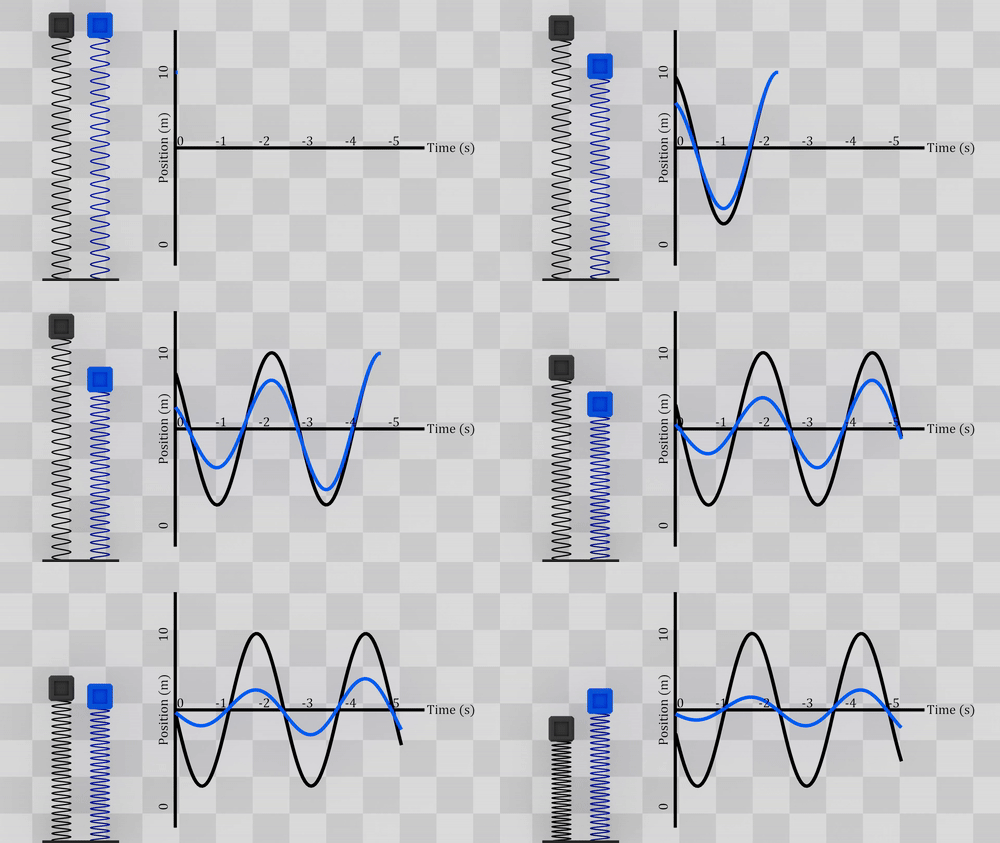
In the absence of anything but the force in the spring itself, the mass will keep moving in the exact same way, repeating its periodic motion. There are no beginnings and no ends: it moves in the same way forever. Consequently, it doesn’t care when and where time began, and I am free to set down my “t = 0” marker wherever I like.
Of course, this isn’t what we see in the real world; slinkies aren’t unstoppable objects burrowing into the depths of hell once they reach the bottom of the staircase. Other forces participate, including that most dreaded complication: friction. The presence of friction opposes the movement of the harmonic oscillator and takes energy out of its system, damping the motion; this oscillator has an end in sight.
Consequently, I have to be careful when declaring the beginning of time for this system. Suddenly, it matters not only where the mass is in its periodic cycle, but also how many cycles have elapsed and how much energy is left in the system. Whereas before the harmonic motion wаs eternal and unyielding, the addition of friction allows it to grow weary with time.
The time-energy connection
The connection between time translation and a system’s energy in the above example is no accident. The connection comes from Noether’s theorem, which states (with a fair bit of handwaving in this version) that any symmetry of a physical system with conservative forces corresponds to a conservation law. Usually (but not always!), when the system is symmetric in time, the corresponding conserved quantity is the total energy.
For our harmonic oscillators, a “conservative” force is effectively one that brings the mass back to where it started from after a full cycle. In the first example above, this fits to a T: it doesn’t matter how many cycles have come and gone, the mass on the spring always reaches the same height. There is a translational symmetry in time, and the total energy of the system remains conserved.
In the second example, this is not the case: the mass extends less and less far as the non-conservative friction saps energy out of the otherwise conservative spring with each cycle. The exact elapsed time is important not just within the auspices of a single period but by the total length of time the friction has been applied. Even if we cleverly translate the time coordinate in some bespoke way, the sheer presence of friction renders Noether’s beautiful theorem moot for this case, and energy can never truly be conserved.
Finally, it’s get-to-the-point o’clock
The New Year is a convention; no matter what the calendar says, I can choose when (or whether) to set resolutions, start a new planner, and look back at the past 12 months. I can choose when the moment of “beginning” is. Just because I don’t feel I’ve “started 2026 off strong” doesn’t mean the rest of my year is doomed to be crap. That’s evidently true.
But it’s also true that we live in a world of friction, and am currently living in a month of much more friction than usual in my life. My energy is not conserved, and my work is not independent of the path taken. I deeply resent the absolute grab bag of bullshit that’s separating me from my own life these days, and I resent that it depletes all the energy I might otherwise use to spring into harmonic motion. I resent that I’m missing out on the animating spirit of the (conventional) January start.
For the past few years I’ve been setting quarterly goals in my life. In a bid to overpower my ADHD, I try to follow the latest goal-setting advice and make them specific and time-constrained—”Do xyz for 12 weeks starting on abc date.” But as I find myself in this hostage situation between my energy and the chaotic forces of friction devouring it whole, I’m nevertheless continually disturbed by the whooshing sound as those hopeful start dates pass me by. Some are gone, never to return; the opportunity is missed. But most can be translated into a more energetically conservative future, if only my perfectionism can learn to accept a late start.
It’s a process, but I’m (path-dependently) working on it. The existence of this essay is proof of that. So, at the very tail end of this very bleak January, I raise my proverbial glass in a non-New Year’s toast:
to starting late;
to starting in Notes apps on the toilet;
to starting in bursts, in segments, in the mind’s eye;
to starting out of spite for fate and circumstance;
to starting in the middle of the month on a Wednesday afternoon;
to starting imperfectly and, in doing so, creating the possibility of being good;
to Noether’s theorem and adventures in time translation and energy conservation.3
Happy New Year; better late than never.
- Reddit immediately warns me not to do this as it can lead to something called “nursemaid’s elbow.” I don’t know, I don’t think my allegorical temporal parents Greg and Jules would do that to me—vacillating between the two can produce unwanted side effects, but they usually leave the elbows be and go straight for the head. ↩︎
- Except we’ve agreed that there never was a year zero, since Christians treat years less as a continuous coordinate/variable and more as a quasi-Boolean operator whose sign answers the question “Has Jesus been on Earth yet y/n?” ↩︎
- With apologies to both Steinbeck and Noether. ↩︎
 Starshine and Mangoes
